Choosing Stone Look Vinyl Tile for international projects requires more than matching a marble photograph. Buyers must balance appearance, performance, installation conditions, and long-term maintenance. A tile may resemble natural limestone, yet behave differently under sunlight, moisture, or heavy foot traffic. That difference matters.
Experienced buyers usually begin with the project environment. A hotel lobby needs strong wear resistance and stable color. A residential bathroom may require better slip performance and moisture tolerance. Commercial kitchens demand careful attention to cleaning chemicals, seams, and surface texture. Ask suppliers for technical data, installation instructions, warranty terms, and recent test reports. Product samples also deserve practical testing. Place them under daylight, warm lighting, and artificial lighting. Walk across them with ordinary footwear. Small color shifts can become obvious across a large floor.
Do not judge quality from images alone. Tile thickness, dimensional stability, backing structure, and surface embossing affect the final result. A deep texture can improve visual realism but may collect dirt. A very smooth finish cleans easily but may appear less natural. There is no perfect choice. Some suppliers provide confident claims without enough supporting evidence, so buyers should verify specifications independently. Check whether testing matches the destination market and project use. Local building, fire, indoor-air-quality, and flooring requirements may differ between countries. Packaging also matters. Strong cartons, clear labels, and moisture protection reduce damage during international transport.
The best decision combines design evidence with supplier reliability. Review samples, documentation, production consistency, and communication before placing a large order. Beautiful flooring is useful only when it performs well after installation.
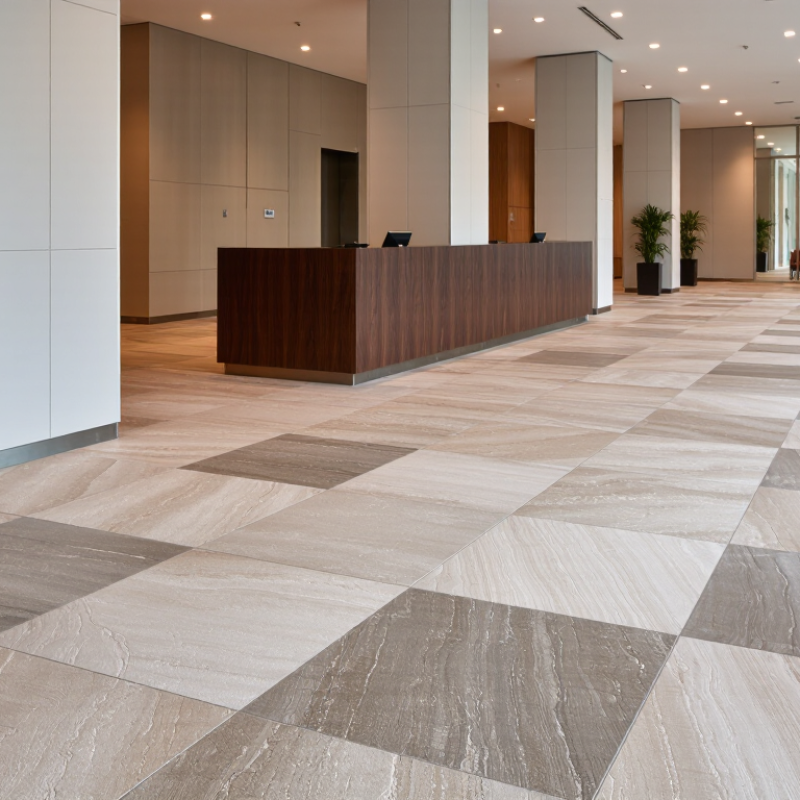
Define Stone-Look Vinyl Tile by PVC Composition, Format, and Global Standards
Stone-look vinyl tile is not simply “PVC with a marble picture.” Global buyers should define it through PVC composition, format, and measurable standards. A typical tile contains a PVC backing, printed décor film, transparent wear layer, and stabilizing additives. Some products add limestone filler, creating a rigid stone-plastic composite core. This improves dimensional stability, but it can reduce flexibility during installation.
Format changes the buying decision. Dry-back LVT suits smooth, carefully prepared floors and commercial refurbishment. Click systems can reduce installation time, especially where adhesive use is restricted. Plank and tile dimensions affect waste, carton weight, and replacement planning. A 600 × 600 mm tile gives a familiar stone layout. Smaller formats may hide cutting errors better. They are not always cheaper.
Market evidence supports careful specification. Grand View Research estimated the global resilient flooring market at about USD 40 billion in 2023, with continued growth expected through 2030. However, market growth does not guarantee product quality. Ask suppliers for results under ISO 10582 or ASTM F1700, depending on the destination. Check wear-layer thickness, dimensional stability, slip resistance, fire classification, and emissions testing. EN 14041 may apply to construction products sold in European markets. Regional requirements still differ.
Details matter most. A glossy surface can reveal scratches under warehouse lighting. A textured surface may collect dust in hotel corridors.
I would also request production samples from different batches. Color consistency can be imperfect, and catalog images rarely show that risk. Superb appearance is useful, but documented performance is safer.
Match Wear-Layer Thickness of 0.20–0.55 mm to Traffic Class
Choosing stone-look vinyl tile starts with the wear layer, not the printed stone pattern. This transparent surface protects against scuffs, grit, and repeated cleaning. In my project reviews, 0.20 mm suits light residential rooms with soft indoor footwear. It can work in bedrooms or quiet studies. Not every hallway.
For busier homes, 0.30 mm offers a safer margin, especially near entrances and kitchens. A 0.40 mm layer is more suitable for heavy residential use and light commercial spaces. In shops, corridors, or classrooms, 0.55 mm usually provides stronger protection against rolling loads and daily abrasion. These ranges should be checked against the stated traffic class, such as residential, commercial, or very heavy commercial classifications. A thickness number alone is not proof of performance.
Global buyers should request test data, surface-finish details, and installation guidance. Subfloor moisture, sharp stone particles, furniture legs, and poor cleaning methods can shorten service life. I have seen thick products fail when the floor beneath them was uneven. That was an expensive reminder. Country-specific standards may also classify the same product differently, so compare the technical sheet carefully. Tile color matters too: pale stone patterns can reveal dirt, while deep textures may hold it. Select the wear layer with the actual traffic, maintenance routine, and local conditions in mind.
How to Choose Stone Look Vinyl Tile for Global Buyers?
Match wear-layer thickness of 0.20–0.55 mm to the intended traffic class.
The chart uses the EN ISO 10874 use-class groups as a purchasing reference. Residential classes 21–23 generally suit 0.20–0.30 mm wear layers, commercial classes 31–34 commonly require about 0.30–0.40 mm, and light-industrial classes 41–43 may require approximately 0.40–0.55 mm. Actual performance also depends on flooring construction, installation quality, rolling loads, moisture, and maintenance conditions.
Verify ASTM F1700, ISO 10582, and EN 14041 Performance Compliance
Choosing stone look vinyl tile for international projects requires more than matching a marble pattern or slate texture. I have seen attractive samples fail when their technical documents were incomplete. Start by checking the exact product construction, wear layer, dimensions, and installation method. A tile should also suit the building’s traffic, moisture exposure, and maintenance routine.
ASTM F1700 is important for solid vinyl tile classification and performance requirements. Confirm whether the tested construction matches the supplied tile. ISO 10582 applies to heterogeneous poly(vinyl chloride) floor coverings, so it can help assess layered products with printed stone designs. Request full test reports, not only a compliance statement. Check sample identification, test dates, methods, and laboratory details. Small differences matter.
EN 14041 addresses essential performance characteristics for resilient floor coverings, including reaction to fire, formaldehyde emissions, slip resistance, and electrical behavior, where applicable. For European projects, review the Declaration of Performance and CE-related documentation carefully. Requirements can vary by intended use and local implementation. Do not assume one certificate covers every market. It may not. Also compare color consistency under daylight, embossing depth, edge accuracy, and cleaning response. A dark stone pattern can hide dust but reveal scratches under strong lighting. I would test several cartons together, because one sample rarely shows production variation. Reliable buying involves technical verification and physical judgment.
Check Slip Resistance Against EN 13893 Class DS Requirements
When choosing stone look vinyl tile for global projects, slip resistance deserves more attention than colour and texture. Check whether the product has been tested under EN 13893, which evaluates dynamic friction on a dry floor surface.
For Class DS, the measured coefficient of friction should generally be at least 0.30. Ask the supplier for a complete laboratory report, not only a catalogue statement. Confirm the tested product code, surface finish, tile thickness, and production batch. A sample may feel secure under a shoe, yet its surface can change after protective film removal or cleaning.
Look closely at the tile under strong light. Deep embossing may improve grip, but it can also collect dust in busy entrances. Glossy stone patterns often appear elegant, but they may hide small scuffs and cleaning residue. Test a sample with the intended footwear and routine detergent. Keep the floor dry during this comparison.
EN 13893 Class DS does not automatically prove safe performance in wet areas. Kitchens, washrooms, and outdoor transitions may require additional regional testing or building-code checks. Confirm these requirements before purchase. Also review installation instructions, because adhesive residue and uneven joints can affect walking safety. The standard is useful, but it is not a perfect answer. Real performance depends on maintenance, moisture, traffic, and installation quality.
Assess EPDs, VOC Limits, Fire Ratings, and ISO 14021 Claims
How to Choose Stone Look Vinyl Tile for Global Buyers?
For global buyers, an Environmental Product Declaration (EPD) deserves careful reading. Check its product category rules, declared unit, life-cycle stages, and verification status. A credible EPD should identify the manufacturing location and validity period. It should also explain whether transport, installation, and disposal are included. Two similar tiles may show different impacts because their boundaries differ. That detail is easy to miss.
VOC compliance requires more than a low-odor sample. Ask for chamber-test results, testing dates, and the exact product reference. Review limits in the destination market, especially for formaldehyde and total VOC emissions. Test the tile with its adhesive when the finished floor system is regulated. Fire performance also depends on the substrate, adhesive, installation method, and room configuration. Check the relevant classification, such as reaction-to-fire or surface-burning results. A passing tile may perform differently in a complete assembly.
ISO 14021 claims are self-declared environmental statements, not automatic third-party certifications. Require evidence for recycled content, recyclability, or reduced-resource claims. Confirm the calculation method and supporting records. “Recyclable” may depend on collection facilities that do not exist locally. That is a real gap. Procurement teams should compare technical sheets, laboratory reports, and shipment documents together. I would not rely on a polished certificate alone. Small inconsistencies can affect customs reviews, green-building submissions, and project approvals. Recheck requirements before each tender.
FAQS
A 0.20 mm wear layer may suit light residential traffic. Soft indoor footwear helps reduce scuffing. Not every hallway.
Choose around 0.30 mm near entrances, kitchens, and frequently used corridors. Grit and furniture movement create extra abrasion.
A 0.40 mm layer suits heavy residential use and light commercial areas. A 0.55 mm layer better handles shops, classrooms, and rolling loads.
No. Check the stated traffic class, test data, surface finish, and installation guidance. A thick tile can fail on an uneven subfloor.
Review the product category rules, declared unit, life-cycle stages, verification, manufacturing location, and validity period. Check transport and disposal boundaries.
Request chamber-test results, testing dates, and the exact product reference. Check destination-market limits for formaldehyde and total VOC emissions.
Not safely. Fire performance depends on the substrate, adhesive, installation method, and room layout. A tile may perform differently within a complete assembly.
No. Self-declared claims require evidence. Check recycled content, recyclability, calculation methods, and supporting records. “Recyclable” may depend on local collection facilities.
Moisture, sharp stone particles, furniture legs, and harsh cleaning methods can cause early damage. Pale patterns show dirt quickly, while deep textures may hold it.
Compare technical sheets, laboratory reports, shipment documents, and local standards. Classifications may differ between markets. I would recheck every tender, because small inconsistencies matter.
Conclusion
Choosing Stone Look Vinyl Tile for global projects requires more than evaluating color and surface appearance. Buyers should first understand the product’s PVC composition, tile or plank format, dimensional stability, and suitability for international market requirements. The wear layer is equally important: options from 0.20 to 0.55 mm can be matched to expected traffic levels, from light residential use to demanding commercial environments. Clear technical documentation helps confirm whether the product meets ASTM F1700, ISO 10582, and EN 14041 performance expectations.
Safety, sustainability, and truthful product claims should also guide purchasing decisions. Slip resistance should be checked against EN 13893 Class DS requirements, while fire performance, VOC emissions, and environmental data should be reviewed before approval. Buyers may also request an Environmental Product Declaration (EPD) and verify that recycled-content or other environmental statements follow ISO 14021 principles. By assessing appearance, durability, compliance, indoor-air quality, and documentation together, global buyers can select Stone Look Vinyl Tile with greater confidence and reduce installation and regulatory risks.